A new synthesis of 4(or 5)-L-aminoethylglyoxaline, one of the active principles of ergot / by Frank Lee Pyman. The synthesis of r-histidine (preliminary note) / by Frank Lee Pyman.
- Pyman, Frank Lee.
- Date:
- [between 1910 and 1919?]
Licence: In copyright
Credit: A new synthesis of 4(or 5)-L-aminoethylglyoxaline, one of the active principles of ergot / by Frank Lee Pyman. The synthesis of r-histidine (preliminary note) / by Frank Lee Pyman. Source: Wellcome Collection.
1/4
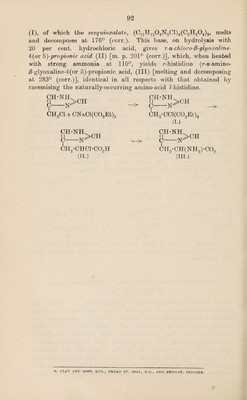
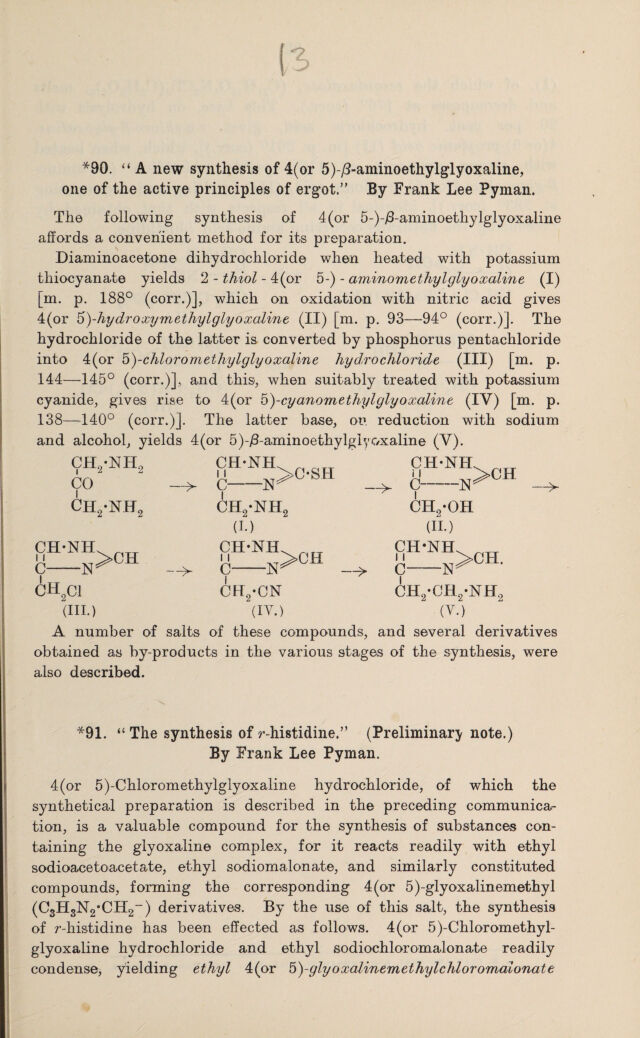
![*90. “ A new synthesis of 4(or 5)-/?-aminoethylglyoxaline, one of the active principles of ergot.” By Frank Lee Pyman. The following synthesis of 4(or 5-)-/3-aminoethylglyoxaline affords a convenient method for its preparation. Diaminoacetone dihydrochloride when heated with potassium thiocyanate yields 2 - thiol - 4(or 5-) - aminomethylglyoxaline (I) [m. p. 188° (corr.)], which on oxidation with nitric acid gives 4(or 5)-hy dr oxy methyl glyoxaline (II) [m. p. 93—94° (corr.)]. The hydrochloride of the latter is converted by phosphorus pentachloride into 4(or 5)-chloromethylglyoxaline hydrochloride (III) [m. p. 144—145° (corr.)], and this, when suitably treated with potassium cyanide, gives rise to 4(or 5)-cyanomethylglyoxaline (IV) [m. p. 138—140° (corr.)]. The latter base, on reduction with sodium and alcohol, yields 4(or 5)-/3-aminoethylglyoxaline (V). ch.2-nh2 co ch2-nh2 —> fPNH>0-SH c- I -N! CH-NIL _rT u >CH C -w ch2-nh2 (I.) CH-NH CH2*OH c ■N! —> 11 O ■N >CH (II.) CH-NH —^ 11 C ■N >CH. CHci (HI.) CH -CN (IY.) ch2-ch2*nh9 (Y.) A number of salts of these compounds, and several derivatives obtained as by-products in the various stages of the synthesis, were also described. *91. “ The synthesis of r-histidine.” (Preliminary note.) By Frank Lee Pyman. 4(or 5)-Chloromethylglyoxaline hydrochloride, of which the synthetical preparation is described in the preceding communica¬ tion, is a valuable compound for the synthesis of substances con¬ taining the glyoxaline complex, for it reacts readily with ethyl sodioacetoacetate, ethyl sodiomalonate, and similarly constituted compounds, forming the corresponding 4(or 5)-glyoxalinemethyl (C3H3N2*CII2“) derivatives. By the use of this salt, the synthesis of r-histidine has been effected as follows. 4(or 5)-Chloromethyl- glyoxaline hydrochloride and ethyl sodiochloromalonate readily condense, yielding ethyl 4(or 5)-glyoxalinemethylchloromalonate](https://iiif.wellcomecollection.org/image/b30622281_0001.jp2/full/800%2C/0/default.jpg)