On the duration of life among the English gentry, with additional observations on the duration of life among the aristocracy / [William A. Guy].
- William Augustus Guy
- Date:
- [1846]
Licence: Public Domain Mark
Credit: On the duration of life among the English gentry, with additional observations on the duration of life among the aristocracy / [William A. Guy]. Source: Wellcome Collection.
1/14
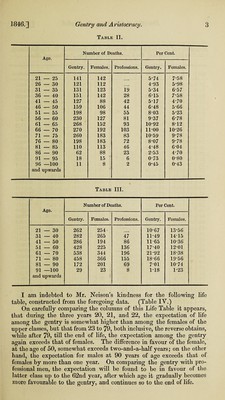
![On the Duration of Life among the English Gentry, with additional observations on the Duration of Life among the Aristocracy. By William A. Guy, M.B., Cantab., Fellow of the Royal College of Physicians, Professor of Forensic Medicine, King’s College, Phy¬ sician to King’s College Hospital, Honorary Secretary to the Statistical Society, &c. [Read before the Statistical Society of London, 19th January, 1846.] In a recent number of the journal of the Statistical Society*, I examined the duration of life among the male members of the families of the Peerage and Baronetage of the United Kingdom; and I now proceed to extend that inquiry to the male members of the families of the English Gentry, and to the females of the Upper Classes. In order, also, to present a more complete view of the duration of life among the higher classes, I shall extend the comparison so as to embrace the members of Royal Houses. The materials for the proposed com¬ parison have been obtained from two distinct sources—the county his¬ tories of Northampton, Cheshire, Berkshire, and Surrey, and the history of Leedst, on the one hand, and the Annual Register, on the other. The facts obtained from the county histories consist of the ages at death of all males and females dying aged 21 and upwards, arranged in three classes :—1. The Male Members of the Families of the Gentry, 2. The Females of the Upper Classes, including the Peerage and Baronetage as well as the Gentry, and 3. The Members of the several Professions. The ages at death are taken partly from the pedigrees of the county families and partly from mural tablets. The comparison which I am about to institute between the results obtained from these sources and from the Peerage and Baronetage is open to several objections, of which the most obvious are the limited number of county and civic histories employed, the admission into that number of one of our large manufacturing towns, and the compara¬ tively ancient date of the histories of Berkshire and Surrey. A more careful and more extensive choice of county histories might have fur¬ nished unexceptionable materials for the comparison; but as a still more satisfactory and accessible record of facts presents itself in the shape of the obituaries contained in the successive numbers of the An¬ nual Register, I have deemed it a better economy of time, to pre¬ sent first the results obtained from the county and civic histories, with all .the objections attaching to them, and then a separate and distinct comparison drawn from the facts gleaned from the Annual Register. County Histories. The following table presents the numbers dying at each age of the three classes—gentry (males); females of the upper classes; and profes¬ sional persons^. The number of the first class is 2455, of the second 1872, and of the third 699. * March, 1845. f Baker’s Northampton; Ormerod’s Cheshire; Ashmole’s Berkshire; Aubrey’s Surrey; and Whitaker’s Leeds. X The professional persons consist of 565 clergy, 57 lawyers, (chiefly barristers,) 30 medical men, (chiefly physicians,) 33 officers of the army, 6 of the navy, and 8](https://iiif.wellcomecollection.org/image/b30559777_0001.jp2/full/800%2C/0/default.jpg)