The composition of salvarsan / by Robert George Fargher and Frank Lee Pyman.
- Fargher, Robert George.
- Date:
- 1920.]
Licence: Public Domain Mark
Credit: The composition of salvarsan / by Robert George Fargher and Frank Lee Pyman. Source: Wellcome Collection.
1/8
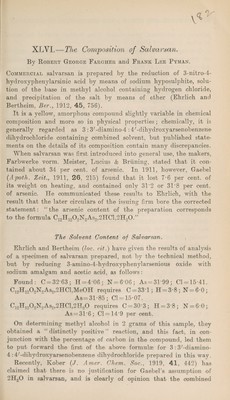
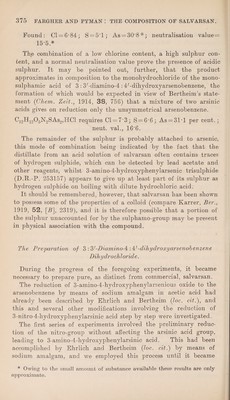
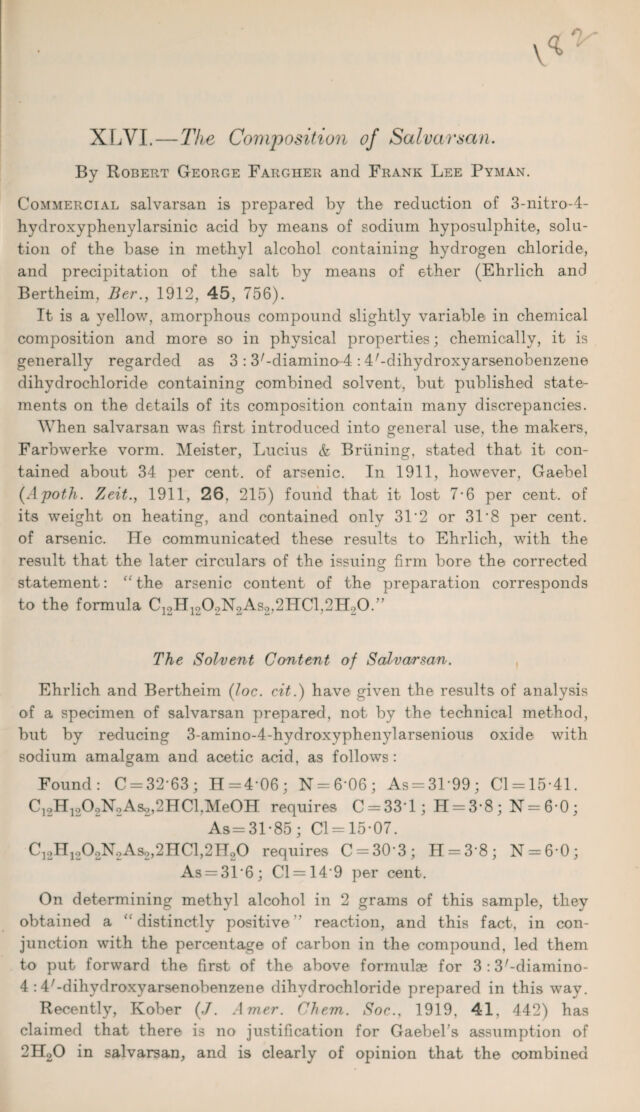
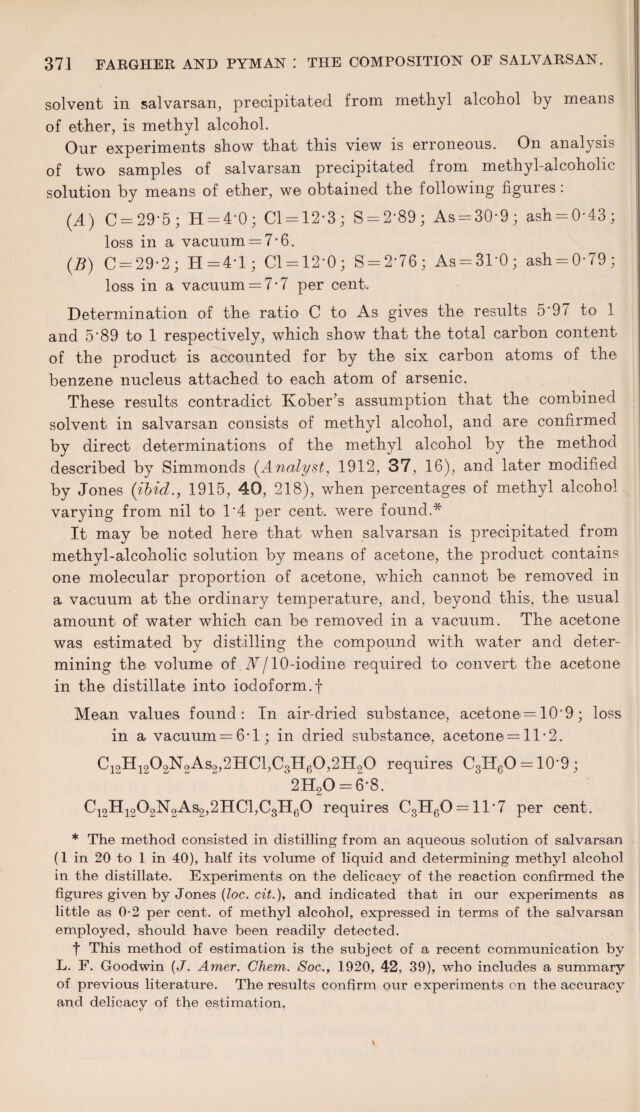
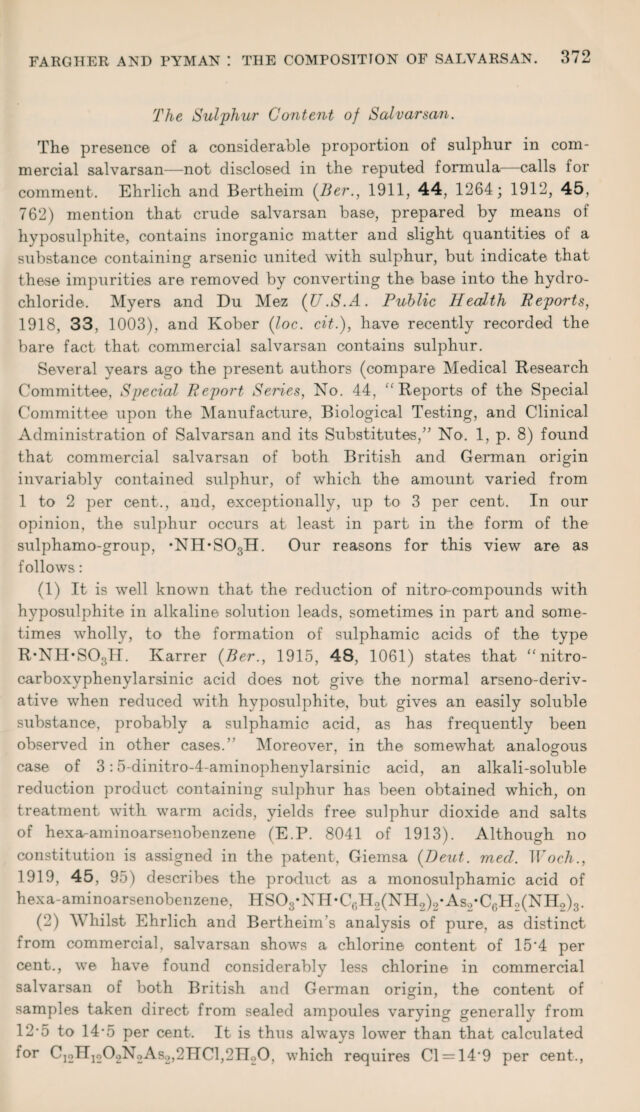
![XLVI.—The Composition of Salvarsan. By Robert George Fargher and Frank Lee Pyman. Commercial salvarsan is prepared by the reduction of 3-nitro-4- hydroxyphenylarsinic acid by means of sodium hyposulphite, solu¬ tion of the base in methyl alcohol containing hydrogen chloride, and precipitation of the salt by means of ether (Ehrlich and Bertheim, Ber., 1912, 45, 756). It is a yellow, amorphous compound slightly variable in chemical composition and more so in physical properties; chemically, it is generally regarded as 3 : S^diamino-I: 4/-dihydroxyarsenobenzene dihydrochloride containing combined solvent, but published state¬ ments on the details of its composition contain many discrepancies. When salvarsan was first introduced into general use, the makers, Farbwerke vorm. Meister, Lucius & Briining, stated that it con¬ tained about 34 per cent, of arsenic. In 1911, however, Gaebel (Apoth. Zeit.y 1911, 26, 215) found that it lost 7-6 per cent, of its weight on heating, and contained only 31*2 or 31*8 per cent, of arsenic. He communicated these results to Ehrlich, with the result that the later circulars of the issuing firm bore the corrected statement: “ the arsenic content of the preparation corresponds to the formula C]2H1202N2As2,2HCl,2H20.” The Solvent Content of Salvarsan. Ehrlich and Bertheim (loc. cit.) have given the results of analysis of a specimen of salvarsan prepared, not by the technical method, but by reducing 3-amino-4-hydroxyphenylarsenious oxide with sodium amalgam and acetic acid, as follows : Found: C = 3263; H=4’06; N = 6‘06; As = 3L99; Cl = 15-41. C12H1202N2As2,2HCl,Me0H requires C = 33'l; H = 3-8; N = 6*0; As = 3L85; Cl = 15-07. C12H1202N2As2,2HC1,2H20 requires C = 3(k3; 11 = 3 8; N = 6-0; As = 31'6; Cl = 14'9 per cent. On determining methyl alcohol in 2 grams of this sample, they obtained a “ distinctly positive ’’ reaction, and this fact, in con¬ junction with the percentage of carbon in the compound, led them to put forward the first of the above formulae for 3 : S'-diamino- 4 :4'-dihydroxyarsenobenzene dihydrochloride prepared in this way. Recently, Kober (.7. Amer. Chem. Soc., 1919, 41, 442) has claimed that there is no justification for Gaebel’s assumption of 2H20 in salvarsan, and is clearly of opinion that the combined](https://iiif.wellcomecollection.org/image/b3062275x_0001.jp2/full/800%2C/0/default.jpg)