Chemical structure and antigenic specificity : a comparison of the crystalline egg-albumins of the hen and the duck / by Henry Drysdale Dakin and Henry Hallett Dale.
- Drysdale Dakin, Henry.
- Date:
- 1919
Licence: Public Domain Mark
Credit: Chemical structure and antigenic specificity : a comparison of the crystalline egg-albumins of the hen and the duck / by Henry Drysdale Dakin and Henry Hallett Dale. Source: Wellcome Collection.
4/16
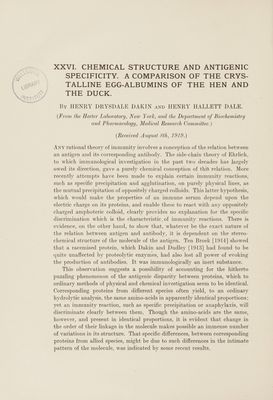
![XXVI. CHEMICAL STRUCTURE AND ANTIGENIC SPECIFICITY. A COMPARISON OF THE CRYS- TALLINE EGG-ALBUMINS OF THE HEN AND THE DUCK. By HENRY DRYSDALE DAKIN ann HENRY HALLETT DALE. (From the Herter Laboratory, New York, and the Department of Biochemistry and Pharmacology, Medical Research Committee. ) (Received August Sth, 1919.) Any rational theory of immunity involves a conception of the relation between an antigen and its corresponding antibody. The side-chain theory of Ehrlich, to which immunological investigation in the past two decades has largely owed its direction, gave a purely chemical conception of this relation. More recently attempts have been made to explain certain immunity reactions, such as specific precipitation and agglutination, on purely physical lines, as the mutual precipitation of oppositely charged colloids. This latter hypothesis, which would make the properties of an immune serum depend upon the electric charge on its proteins, and enable these to react with any oppositely charged amphoteric colloid, clearly provides no explanation for the specific discrimination which is the characteristic, of immunity reactions. There is evidence, on the other hand, to show that, whatever be the exact nature of the relation between antigen and antibody, it is dependent on the stereo- chemical structure of the molecule of the antigen. Ten Broek [1914] showed that a racemised protein, which Dakin and Dudley [1913] had found to be quite unaffected by proteolytic enzymes, had also lost all power of evoking the production of antibodies. It was immunologically an inert substance. This observation suggests a possibility of accounting for the hitherto puzzling phenomenon of the antigenic disparity between proteins, which to ordinary methods of physical and chemical investigation seem to be identical. Corresponding proteins from different species often yield, to an ordinary hydrolytic analysis, the same amino-acids in apparently identical proportions; yet an immunity reaction, such as specific precipitation or anaphylaxis, will discriminate clearly between them. Though the amino-acids are the same, however, and present in identical proportions, it is evident that change in the order of their linkage in the molecule makes possible an immense number of variations in its structure. That specific differences, between corresponding proteins from allied species, might be due to such differences in the intimate - pattern of the molecule, was indicated by some recent results,](https://iiif.wellcomecollection.org/image/b33454280_0004.jp2/full/800%2C/0/default.jpg)