Chemical structure and antigenic specificity : a comparison of the crystalline egg-albumins of the hen and the duck / by Henry Drysdale Dakin and Henry Hallett Dale.
- Drysdale Dakin, Henry.
- Date:
- 1919
Licence: Public Domain Mark
Credit: Chemical structure and antigenic specificity : a comparison of the crystalline egg-albumins of the hen and the duck / by Henry Drysdale Dakin and Henry Hallett Dale. Source: Wellcome Collection.
5/16
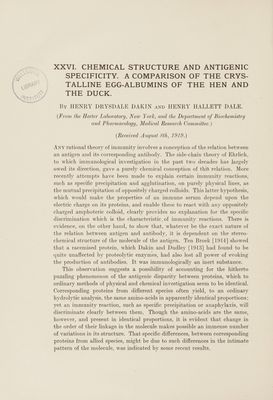
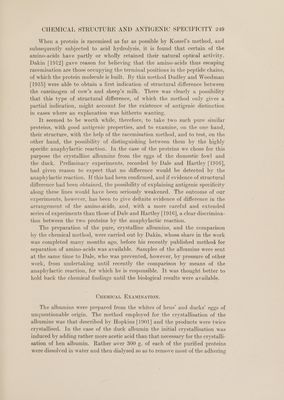
![When a protein is racemised as far as possible by Kossel’s method, and subsequently subjected to acid hydrolysis, it is found that certain of the amino-acids have partly or wholly retained their natural optical activity. Dakin [1912] gave reason for believing that the amino-acids thus escaping racemisation are those occupying the terminal positions in the peptide chains, of which the protein molecule is built. By this method Dudley and Woodman [1915] were able to obtain a first indication of structural difference between the caseinogen of cow’s and sheep’s milk. There was clearly a possibility that this type of structural difference, of which the method only gives a partial indication, might account for the existence of antigenic distinction in cases where an explanation was hitherto wanting. It seemed to be worth while, therefore, to take two such pure similar proteins, with good antigenic properties, and to examine, on the one hand, their structure, with the help of the racemisation method, and to test, on the other hand, the possibility of distinguishing between them by the highly specific anaphylactic reaction. In the case of the proteins we chose for this purpose the crystalline albumins from the eggs of the domestic fowl and the duck. Preliminary experiments, recorded by Dale and Hartley [1916], had given reason to expect that no difference would be detected by the anaphylactic reaction. If this had been confirmed, and if evidence of structural difference had been obtained, the possibility of explaining antigenic specificity along these lines would have been seriously weakened. The outcome of our experiments, however, has been to give definite evidence of difference in the arrangement of the amino-acids, and, with a more careful and extended series of experiments than those of Dale and Hartley [1916], a clear discrimina- tion between the two proteins by the anaphylactic reaction. The preparation of the pure, crystalline albumins, and the comparison by the chemical method, were carried out by Dakin, whose share in the work was completed many months ago, before his recently published method for separation of amino-acids was.available. Samples of the albumins were sent at the same time to Dale, who was prevented, however, by pressure of other work, from undertaking until recently the comparison by means of the anaphylactic reaction, for which he is responsible. It was thought better to hold back the chemical findings until the biological results were available. CHEMICAL HXAMINATION. The albumins were prepared from the whites of hens’ and ducks’ eggs of unquestionable origin. The method employed for the crystallisation of the albumins was that described by Hopkins [1901] and the products were twice crystallised. In the case of the duck albumin the initial crystallisation was induced by adding rather more acetic acid than that necessary for the crystalli- sation of hen albumin. Rather over 300 g. of each of the purified proteins were dissolved in water and then dialysed so as to remove most of the adhering](https://iiif.wellcomecollection.org/image/b33454280_0005.jp2/full/800%2C/0/default.jpg)