Chemical structure and antigenic specificity : a comparison of the crystalline egg-albumins of the hen and the duck / by Henry Drysdale Dakin and Henry Hallett Dale.
- Drysdale Dakin, Henry.
- Date:
- 1919
Licence: Public Domain Mark
Credit: Chemical structure and antigenic specificity : a comparison of the crystalline egg-albumins of the hen and the duck / by Henry Drysdale Dakin and Henry Hallett Dale. Source: Wellcome Collection.
6/16
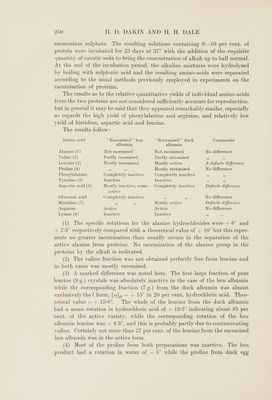
![ammonium sulphate. The resulting solutions containing 8—10 per cent. of protein were incubated for 23 days at 37° with the addition of the requisite quantity of caustic soda to bring the concentration of alkali up to half normal. At the end of the incubation period, the alkaline mixtures were hydrolysed by boiling with sulphuric acid and the resulting amino-acids were separated according to the usual methods previously employed in experiments on the racemisation of proteins. The results as to the relative quantitative yields of individual amino-acids from the two proteins are not considered sufficiently accurate for reproduction, but in general 1t may be said that they appeared remarkably similar, especially as regards the high yield of phenylalanine and arginine, and relatively low yield of histidine, aspartic acid and leucine. The results follow: Amino acid ‘“*Racemised”’ hen ‘“*Racemised”’ duck Comments albumin albumin Alanine (1) Not racemised Not racemised No difference Valine (2) Partly racemised Partly racemised es * Leucine (3) Mostly racemised Mostly active A definite difference Proline (4) & ms Mostly racemised No difference Phenylalanine Completely inactive Completely inactive - re Tyrosine (5) Inactive Inactive ee ae Aspartic acid (6) Mostly inactive, some Completely inactive Definite difference active Glutamic acid Completely inactive . 5 No difference Histidine (7) 55 ns Mostly active Definite difference Arginine Active Active No difference Lysine (8) Inactive Inactive s (1) The specific rotations for the alanine hydrochlorides were + 6° and + 7-5° respectively compared with a theoretical value of + 10° but this repre- sents no greater racemisation than usually occurs in the separation of the active alanine from proteins. No racemisation of the alanine group in the proteins by the alkali is indicated. (2) The valine fraction was not obtained perfectly free from leucine and in both cases was mostly racemised. (3) A marked difference was noted here. The first large fraction of pure leucine (9 g.) crystals was absolutely inactive in the case of the hen albumin while the corresponding fraction (7 g.) from the duck albumin was almost exclusively the / form, [a], = + 15° in 20 per cent. hydrochloric acid. Theo- retical value = + 15-6°. The whole of the leucine from the duck albumin had a mean rotation in hydrochloric acid of + 13-3° indicating about 85 per cent. of the active variety, while the corresponding rotation of the hen albumin leucine was + 4:3°, and this is probably partly due to contaminating valine. Certainly not more than 27 per cent. of the leucine from the racemised hen albumin was in the active form. (4) Most of the proline from both preparations was inactive. The hen product had a rotation in water of — 5° while the proline from duck egg](https://iiif.wellcomecollection.org/image/b33454280_0006.jp2/full/800%2C/0/default.jpg)