The release of histamine from cat's isolated perfused skin by amino-acids / by Eleanor Eldridge and W.D.M. Paton.
- Date:
- [1954?]
Licence: In copyright
Credit: The release of histamine from cat's isolated perfused skin by amino-acids / by Eleanor Eldridge and W.D.M. Paton. Source: Wellcome Collection.
1/2
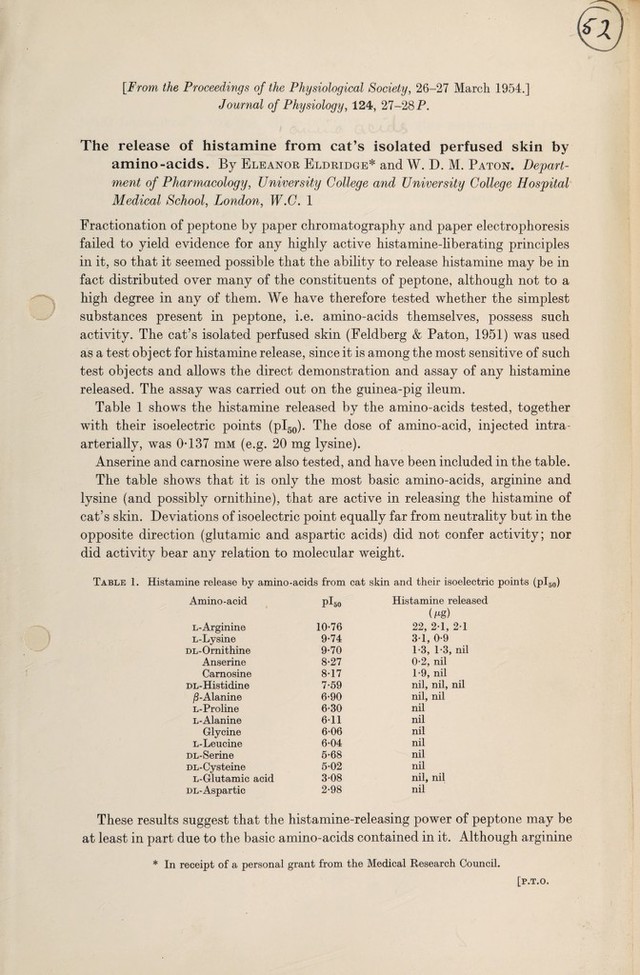
![[From the Proceedings of the Physiological Society, 26-27 March 1954.] Journal of Physiology, 124, 27-28 P. The release of histamine from cat’s isolated perfused skin by amino-acids. By Eleanor Eldridge* and W. D. M. Paton. Depart¬ ment of Pharmacology, University College and University College Hospital Medical School, London, W.C. 1 Fractionation of peptone by paper chromatography and paper electrophoresis failed to yield evidence for any highly active histamine-liberating principles in it, so that it seemed possible that the ability to release histamine may be in fact distributed over many of the constituents of peptone, although not to a high degree in any of them. We have therefore tested whether the simplest substances present in peptone, i.e. amino-acids themselves, possess such activity. The cat’s isolated perfused skin (Eeldberg & Paton, 1951) was used as a test object for histamine release, since it is among the most sensitive of such test objects and allows the direct demonstration and assay of any histamine released. The assay was carried out on the guinea-pig ileum. Table 1 shows the histamine released by the amino-acids tested, together with their isoelectric points (pl50). The dose of amino-acid, injected intra¬ arterially, was 0-137 mM (e.g. 20 mg lysine). Anserine and carnosine were also tested, and have been included in the table. The table shows that it is only the most basic amino-acids, arginine and lysine (and possibly ornithine), that are active in releasing the histamine of cat’s skin. Deviations of isoelectric point equally far from neutrality but in the opposite direction (glutamic and aspartic acids) did not confer activity; nor did activity bear any relation to molecular weight. Table 1. Histamine release by amino-acids from cat skin and their isoelectric points (pl50) Amino-acid PEo Histamine released (pg) L-Arginine 10-76 22, 2-1, 2-1 L-Lysine 9-74 3-1, 0-9 dl-Ornithine 9-70 1-3, 1-3, nil Anserine 8-27 0-2, nil Carnosine 8-17 T9, nil DL-Histidine 7-59 nil, nil, nil P-Alanine 6-90 nil, nil l- Proline 6-30 nil l-Alanine 6-11 nil Glycine 6-06 nil L-Leucine 6-04 nil DL-Serine 5-68 nil dl-Cysteine 5-02 nil l- Glutamic acid 3-08 nil, nil DL-Aspartic 2-98 nil These results suggest that the histamine-releasing power of peptone may be at least in part due to the basic amino-acids contained in it. Although arginine * In receipt of a personal grant from the Medical Research Council. [p.t.o.](https://iiif.wellcomecollection.org/image/b30633886_0001.jp2/full/800%2C/0/default.jpg)