Hello, this is curator Shamita Sharmacharja again.
On the wall is a dark red shelf. Resting on it is a sakazuki [sah-kah-zoo-key], a traditional Japanese sake cup, which you are invited to touch. This example, made around ten years ago, is crafted from a silver-plated nickel alloy.
The cup measures ten and a half centimetres in diameter and three and a half centimetres in height, designed to sit comfortably in one hand. It is shaped like a shallow, wide bowl, supported by a short, rounded pedestal base.
The interior surface, where sake would be poured, has a soft matte finish. At its centre is an engraved Japanese character meaning “longevity”, polished to a bright sheen so that it catches the light.
Cups like this carry a symbolic meaning in Japan. Much in the same way as people in the UK receive a letter from the monarch on their 100th birthday, the Japanese government presents every citizen who reaches 100 with a commemorative sake cup.
These presentations take place each year on Respect for the Aged Day, a national holiday celebrating older people. When the tradition began in 1963, the cups were made from solid silver, and only 153 people received one. By 2014, more than 29,000 people were due to receive a cup, at a cost of around £1.2 million. The expense was deemed unsustainable and the scheme was briefly halted. Following a public outcry, it was reinstated, using a more affordable material, like the silver-nickel cup that you have in front of you.
Today, Japan has one of the longest life expectancies in the world and is considered an advanced “super-ageing” society. Around 30 per cent of its population is over 65, and the number of people reaching their 100th birthday has risen steadily each year since 1971. At the same time, birth rates have declined, as people choose to have fewer children, or to have them later in life.
These patterns – longer lives and lower birth rates – are reshaping societies across the globe. By 2030, it is estimated that the UK will also become a “super-ageing” society, with more than a fifth of its population aged over 65. While longer life is something to celebrate, it also raises pressing questions about how to care for ageing populations with fewer working-age people to support them, a challenge felt especially keenly in Japan.
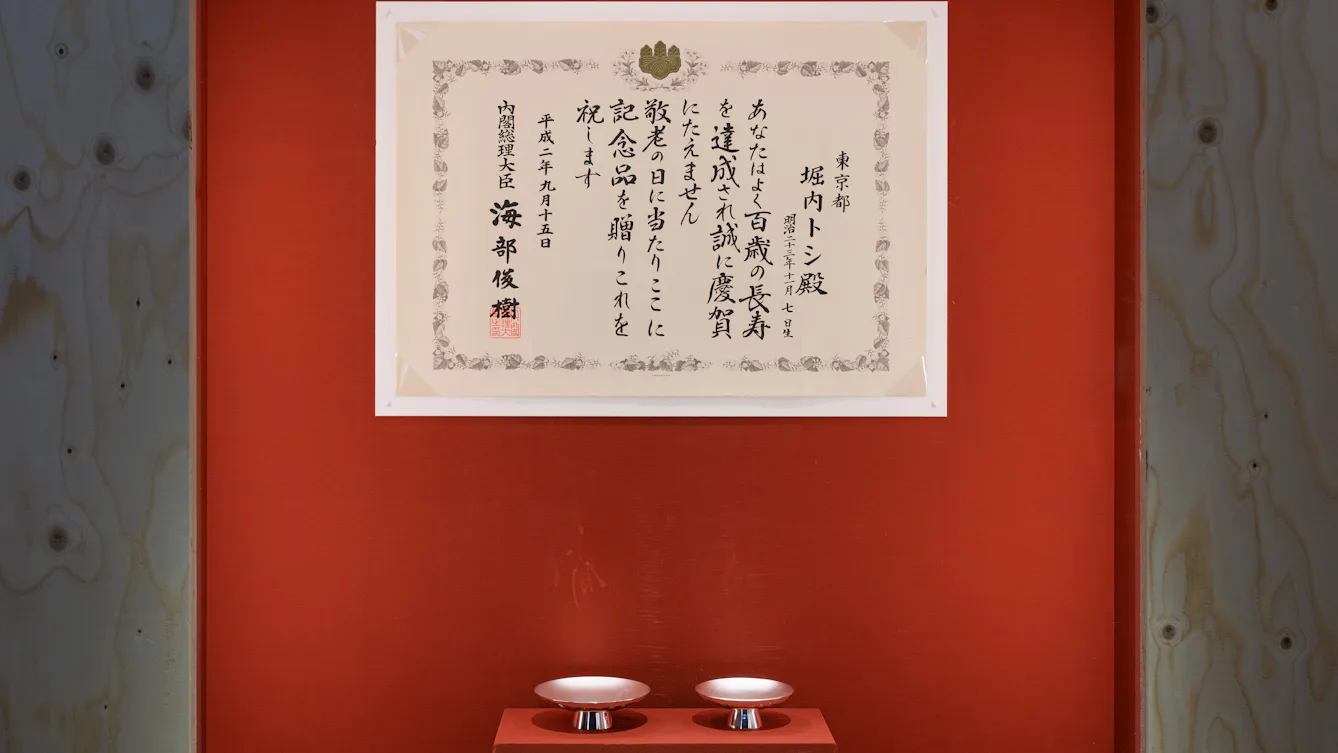
About one metre to the right is a display case lined with red fabric. Inside are two sake cups. The cup on the left is made out of pure silver; the one on the right is the more affordable nickel alloy.
Above them hangs a certificate; these are presented with the cups. Mounted against the back wall of the case, it measures 36 centimetres high by 51 centimetres wide. The creamy paper is bordered on all four sides with a delicate vine-like pattern of grey leaves and flowers. At the top, within the border, sits a small golden emblem. Across the page, several vertical columns of formal Japanese calligraphy are written in black ink.
Translated into English, the text reads:
“You have achieved longevity of 100 years, and we are truly grateful for that. On the occasion of Respect for the Aged Day, we would like to present a commemorative gift to celebrate the occasion.”
It is signed by the Prime Minister of Japan.
This subtle shift in material – from solid silver to nickel alloy – reflects much larger questions facing Japan today. These cups are not simply personal gifts; they are symbols of gratitude, public policy, economic reality and social values.
Do we value a 100‑year life differently when it is increasingly common?
This is the end of Stop 3.