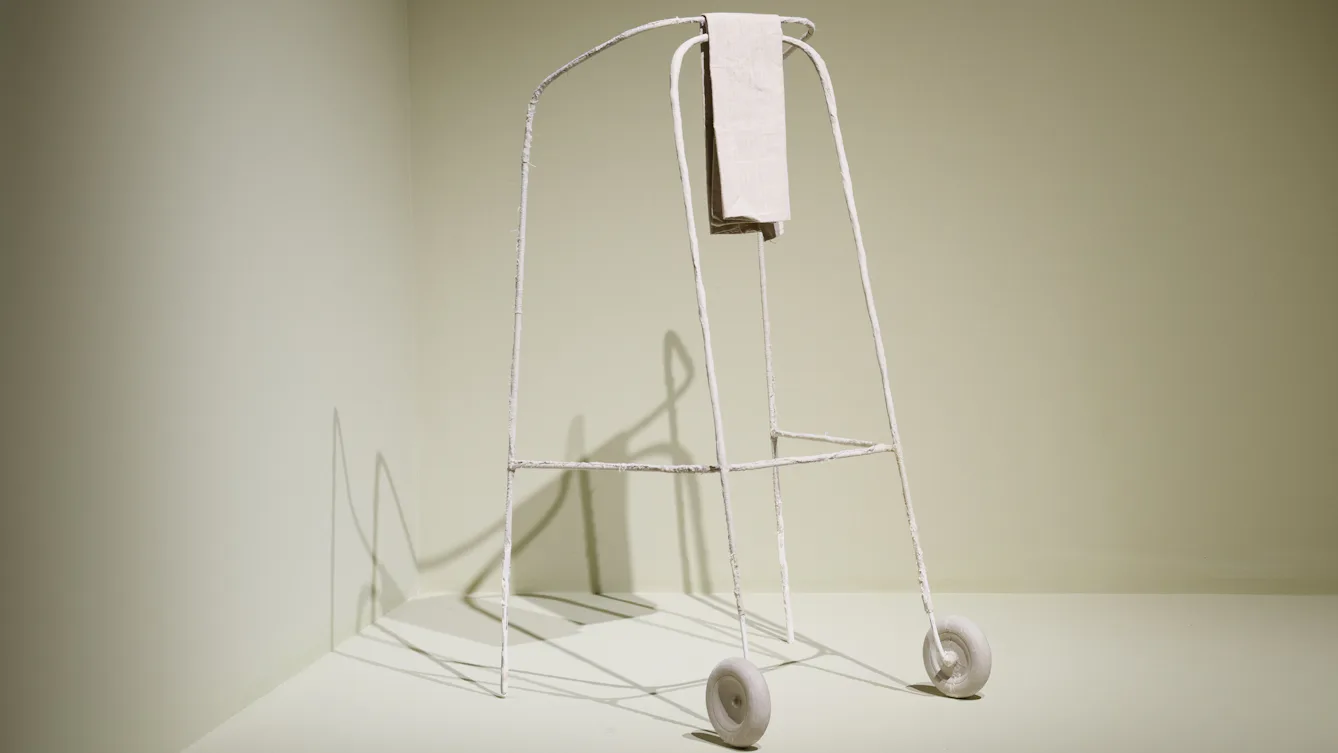
You are facing a low square plinth where a pale grey sculpture of a Zimmer frame is displayed. Designed to foster independence, Zimmer frames are also associated with vulnerability.
This delicate sculpture by Irish artist Daphne Wright explores this tension between support and frailty.
It is 92 centimetres tall and has four extremely slender legs, two of which end in small, solid, round clay wheels at the front.
The pale grey surface of the clay is slightly uneven and looks brittle.
A piece of beige-coloured linen cloth, evoking domesticity and personal care, hangs over the top of the frame, draping down at the front. The overall impression is of poignant vulnerability.
“Okay, hi, I’m Daphne Wright and I’m an artist, and I’ve made the work in the show called Zimmer.
I began this body of work using the unfired clay, and it took me, I worked with for over seven years, and during that period, I was Mum at home, and I found a lot of the things that I was drawn to were like household objects, and I began to look at the importance and the relevance of those objects, and also how certain times would be very vital to our life, like the children’s buggy, the pushchair, or the shopping trolley, and in this case, it’s the Zimmer frame. That these things are vital to us and are almost an extension of our bodies. And there are particular times in your life where you might be caring for elderly parents, and we saw that the children’s buggy got disregarded, and at the same time, members in our household would have been considering a Zimmer frame, because it’s a huge psychological jump for an elderly person or a person who’s unwell or needs certain extra mobility.
“But for them, it’s like an aid, but it also it felt like a signal to vulnerability. And lots of elderly people that I knew absolutely rejected it, and then as time went on, actually setting off in it and accepting it, there would be this whole other renewal of mobility and renewal of life. And it became like this absolute necessity, an extension of the bone of the body. And I think with the way I worked the material, and I just took the outline skeleton of the Zimmer that I suppose I really recognised the human body becoming more skeletal-like, and this was a particular extension of that. So the fragility and the vulnerability and the anxiety you felt for somebody up, mobile with their Zimmer still is there, and it’s it somehow is sucked into the emotion of this little piece of metal.”
This is the end of Stop 4.