Hello, this is curator Ruth Horry again.
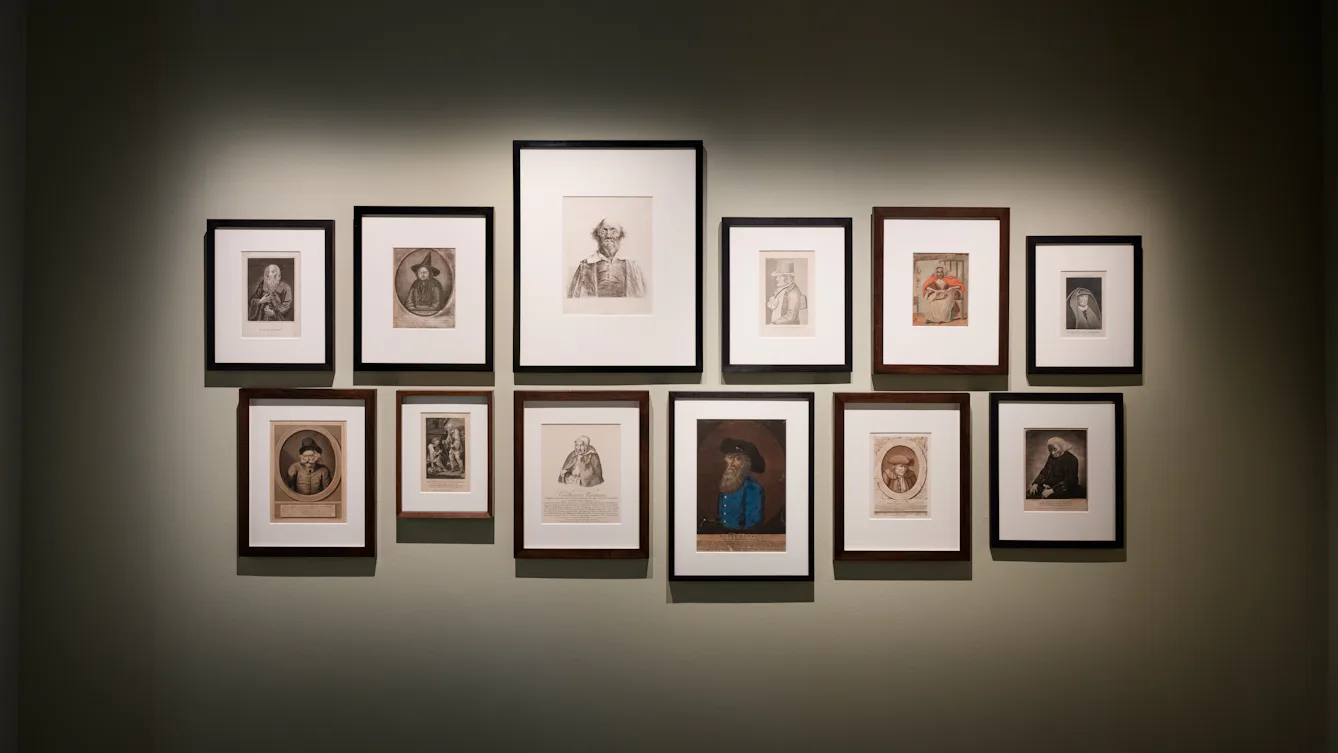
Hanging on the wall are 12 European portrait prints from Wellcome Collection, dating from the 17th to 19th centuries. They are displayed in two rows of six, each mounted in a wooden frame. All of these prints feature people who supposedly lived to be extremely old.
Three of the prints will be described.
We begin on the upper row, with the second print from the left. It is by English artist John Faber from 1710, measuring 41 cm high by 35 cm wide. It’s monochrome, on browning paper, showing its age. It depicts Jane Scrimshaw, who is supposedly aged 126; she is an older, light-skinned woman. She is pictured in an oval medallion frame, facing forward and looking directly at us with a calm, serious expression. Her face is lined with deep wrinkles and she wears a tall, pointed, wide-brimmed black hat – reminiscent of a witch’s hat – and a dark cloak that covers her shoulders and chest. A neck cloth is tied beneath her chin, framing her face. It is likely the uniform of the almshouses where she lived.
Beneath the portrait is the printed text in capital letters stating that she was still alive at 126 years old on April 3, 1710 when the print was made. Below the oval frame is a longer inscription giving details of Scrimshaw’s place of birth, and her residence in Tower Hill almshouses, London.
Did Jane Scrimshaw really live to 126? It’s unlikely.
People did regularly live into older age in the past, even when average life expectancy was much lower. Yet precise numerical age was often uncertain and records kept by churches often relied on self‑description.
Accounts of people living far beyond 100 at that time are likely untrue: a mix of wishful thinking and legendary stories. Certainly, no one has lived to 164 or 172, despite the claims for Sarah and John Rovin, whose portrait will be described next.
On the lower row, the second print from the left is a smaller monochrome engraving from 1814 by an unknown artist, showing an old-aged, light-skinned couple, John and Sarah Rovin, who were from Hungary. According to the inscription at the bottom, when the print was made John was aged 172 and Sarah 164.
John Rovin stands on the right side of the portrait, stooping slightly as he leans on the walking stick in his right hand. His hair and beard are white and he has a serious expression. He wears a loose, light-coloured jacket and trousers, and open shoes strapped at the ankles. In his left arm he is carrying what looks like a bundle of grain.
Sarah Rovin sits on a low bench on the left side of the print. She wears a headscarf and a long, light-coloured robe with a darker garment, like an apron or shawl, wrapped over it. Her body is turned slightly toward her husband, but she looks directly out at us. Her face is deeply lined, and her expression appears attentive, thoughtful and serious. At her feet, a small cat lies curled on the ground. Behind the couple we glimpse an open fire.
The third and final portrait to be described is on the lower row, furthest to the right. This is a monochrome engraving produced in 1797 by John Yeatherd after a painting by John Nash. It depicts a light-skinned man, Isaac Ingall – aged 118, according to the inscription at the bottom of the portrait. He is seated against a plain, softly shaded background. He has a deeply lined face, thin lips, and a solemn, dignified expression.
He wears a neat white wig with short curly waves, styled in 18th-century fashion. He has a dark, heavy coat with buttons and wide cuffs embroidered with lines. (The coat could be velvet or another thick material, suggesting good quality.) Underneath, a dark waistcoat is visible and a white shirt collar. His posture is stooped and both hands rest on the handle of a walking cane positioned vertically between his knees.
Beneath the image is an inscription saying that Ingall, aged 118, was living with Lady Webster’s family at Battle Abbey in Sussex. He had reportedly served as a domestic servant there for 90 years. Ingall’s gravestone at Battle Church still exists, and says he lived to an age of 120.
All these prints showing supposedly super-aged people such as Ingall, are known as ‘broadsides’ – it was a way in the 1700s and 1800s of sharing these stories and images. This fascination with extreme old age still exists today, and this is why I wanted to include these prints in the exhibition.
Media stories still appear regularly about people aged over 100, asking these centenarians to share their secrets to long life. And assuming that there IS such a ‘secret’ that can be shared with others.
The oldest human, according to modern records was Jeanne Calment, a French woman who lived to 122. She was born in 1875 and died in 1997. Her story became very well known – just like John and Sarah Rovin, and Isaac Ingall were well known in the past.
This is the end of Stop 5.