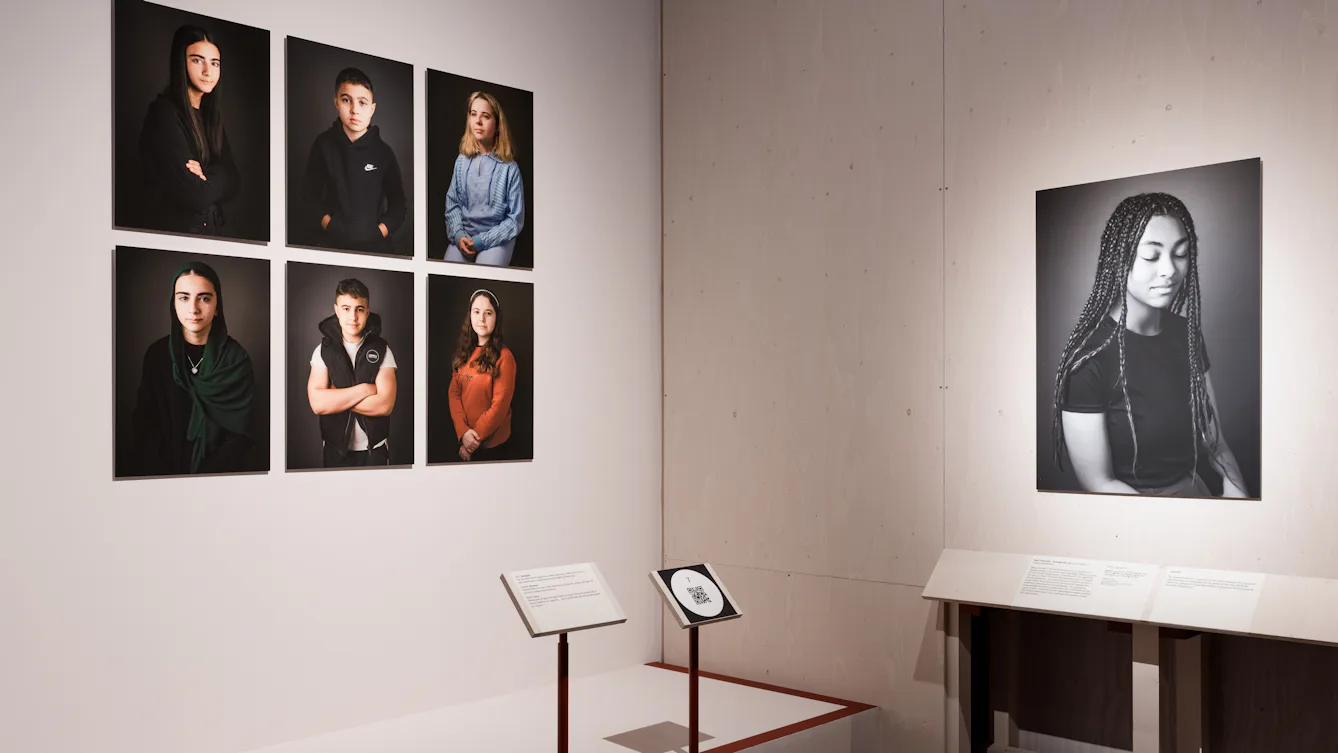
My name is Carolyn Mendelson and I am the artist and photographer behind the project ‘Age of Wonder’. This ongoing photographic portrait series explores the lives of young people in Bradford, starting from around 12 or 13 years old, and following them until they reach 18 or 19.
This project is part of my work as artist-in-residence for ‘Born in Bradford’, a research programme that tracks the lives of over 60,000 people to understand what keeps families healthy and happy.
Participation is at the heart of my work. Each young person helps co-produce their portrait.
It is really important to me that their voices are heard and that they feel actively involved in the project and are at the centre of their own story.
The photographs on display show a very small selection, just two images each, of three of the young people taking part.
I have been photographing the same 25 young people each year and will continue until they reach adulthood.
I make the portrait with them, and then I ask the questions and record them talking about their lives.
As a body of work, we see each young person grow up, but as well as how they change physically, the series offers an insight into how their sense of identity, their beliefs about the world and their aspirations for the future have changed.
We are now going to hear from Lucy, whose portraits are on display on the right.
Carolyn: Lucy, you’ve been photographed three times as part of the project, and you’re coming up to your fourth portrait. What is it like for you to have your portrait made every year?
Lucy: I find it amazing that it captures the growth of me as a person over the years. At the beginning, I was really nervous and didn’t know how to act around the camera. But now I’m more comfortable and relaxed around it, and I just feel like a lot more prepared for it, because sometimes I don't think you realise it within yourself that you change until, I guess, it’s captured into a photo like this.
It’s so amazing, yet a weird feeling to see, because you have the memories of that time, the emotions and everything that comes back to you around the time, even the good and the bad, and having that captured in a photo, it’s amazing to look back on.
Carolyn: Do you think that your relationship to the camera changed as you got older?
Lucy: I definitely think it did. I just feel more comfortable and relaxed, almost like seeing myself from a third perspective. And it’s also that creative bond between us both. It’s also got that collaborative side, where we both make it together, to get the perfect result.
Carolyn: Being able to choose how you are represented is a big part of the work. I invite you to wear the clothes of your choice. What did that freedom mean to you? And how did you decide how you wanted to present yourself?
Lucy: It meant a lot, because how we represent ourselves is how many people get an impression of us when we first see each other. So me choosing what I want to wear is how I express myself. Did I want to see a calmer side? Did I want other people to see that? Did I want to have a brighter and more bolder side? And I find that really important, because first impressions mean a lot to people. So being able to express that meant a lot.
Carolyn: Looking at these portraits now, taken at different moments in time, what do they represent to you? And what do you hope visitors might take away from them?
Lucy: They represent to me, the growth and change within myself, the confidence that grew within me. You can see I’m definitely a lot more confident around the camera in the second photo, and I’m wearing my brighter and bold clothing because I felt more comfortable. And I hope that visitors take away the memories of their adolescence and can compare it to my own.
Carolyn: When I look at the portraits, after having worked with you across a good few years and knowing that I’m going to work with you over the next few years as you, as you grow up through adolescence towards adulthood, I just feel it’s such a privilege to be part of that journey, in that we work together to make those portraits and that I actually see your change, not only your physical change, but also I’m interviewing you, and it’s your emotional change, your attitudes change, your confidence is growing. So all those things come to me when I look at them. You know, my, our relationship over the years of making the work, I hope visitors are able to see the individuals behind the portraits, and that they’re able, like you were saying, to relate to their own experiences and that it gives you a voice and a presence, and that the visitors to the exhibition see that.
This is the end of Stop 7.