Losses in boiling vegetables and the composition and digestibility of potatoes and eggs / by H. Snyder, Almah J. Frisby, and A.P. Bryant.
- Harry Snyder
- Date:
- 1897
Licence: Public Domain Mark
Credit: Losses in boiling vegetables and the composition and digestibility of potatoes and eggs / by H. Snyder, Almah J. Frisby, and A.P. Bryant. Source: Wellcome Collection.
11/34 page 9
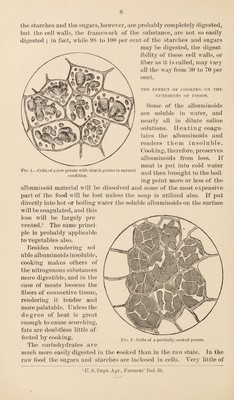
![the cellulose of the cell walls is digested by man. The cell contents, therefore, are often excreted unchanged. Cooking bursts these cell walls, thus exposing the inclosed sugars and starches to the action of tbe digestive juices. The starch granules also swell up and burst on cooking, exposing more surface to be acted upon. Starch is to a slight extent changed to dextrin by dry heat, and possibly, also, by heating with water. Since the majority of vegetable foods, however, consist largely of starches and have very little sugar in them, the loss of carbohy¬ drates would presumably not be very great during boiling. The effect of boiling upon the cells of the potato is shown in figs. 1, 2, and 3.1 Several years ago Kath¬ erine Williams reported2 an extended study of the composition of a number of cooked and a few raw vege¬ tables. Ultimate and prox¬ imate analyses of the vari¬ ous vegetables were made and the fuel value deter¬ mined. Many cooked veg¬ etables have been analyzed in connection with the food investigations undertaken by this Department and by other investigators. Comparatively few attempts have been made to learn the changes which take place in vegetable foods on cooking, or the extent of these changes. As the water in which vegetables are boiled is usually thrown away, any matter which was in solution would be wasted. Experiments were therefore undertaken with potatoes, carrots, and cabbage for the purpose of studying the loss of nutrients when boiled, under a number of different conditions. These vegetables were selected as the best representatives of tubers, roots, and pot herbs. EXPERIMENTS WITH POTATOES. COMPOSITION OF POTATOES. According to Lawes and Gilbert,3 the composition of the flesh of the potato differs from that of the juice. Although the flesh contains 85 per cent of the total water-free substance, it contains but 15 per cent of 1 U. S. Dept. Agr., Office of Experiment Stations Bui. 21, p. 88; from Marcker’s Stu- dien in der Spiritusfabrikation. 2 Jour. Chem. Soc. [London], 61 (1892), p. 226. 3 “On tlie growth of the potato,” p. 26, Rothamsted Memoirs, vol. 6. Pig. 3.—Cells of a thoroughly boiled potato.](https://iiif.wellcomecollection.org/image/b30472490_0011.jp2/full/800%2C/0/default.jpg)