Losses in boiling vegetables and the composition and digestibility of potatoes and eggs / by H. Snyder, Almah J. Frisby, and A.P. Bryant.
- Harry Snyder
- Date:
- 1897
Licence: Public Domain Mark
Credit: Losses in boiling vegetables and the composition and digestibility of potatoes and eggs / by H. Snyder, Almah J. Frisby, and A.P. Bryant. Source: Wellcome Collection.
28/34 page 26
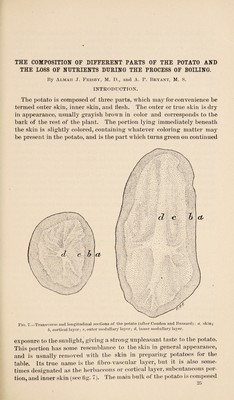
![of cells filled with starch grains and a little nitrogenous matter, and may be designated as the flesh of the potato. [Shortly after the completion of the present bulletin an extended study of potatoes was reported by H. Coudon and L. Bussard.1 The authors investigated the botanical structure of a large number of vari¬ eties of potatoes and determined the relative composition of large, medium, and small potatoes and of the different parts of the tubers. The taste and culinary properties of a number of standard varieties were also investigated. The potatoes were cooked in several ways. Among the conclusions reached by the authors were the following: In judging the value of a variety of potatoes analyses should be made of a number of entire tubers. The culinary value of the potato is directly proportional to its nitrogen content and inversely proportional to its starch content. The different varieties of potatoes were found to vary greatly in their resistance to boiling, some retaining their form com¬ pletely, while others were almost entirely disintegrated. In the authors opinion the resistance to boiling did not depend upon the con¬ tent of pectin or starch, but seemed to depend principally upon the relative proportion of albuminoids present. No definite relation was observed between chemical composition and early maturity. Generally speaking, the early varieties contained more water and nitrogenous material and less starch than the late varieties. The number of excep¬ tions was, however, large.] In order to ascertain to some extent the variation in composition of the different parts of the tuber a quantity of smooth potatoes of aver¬ age size was obtained and analyses of the different parts made. The variety selected was that known as the u White Star.’7 COMPOSITION OF DIFFERENT PARTS OF THE POTATO. SAMPLING. Twelve medium-sized jiotatoes of known weight were taken. The skin was carefully removed by scraping with a knife and the skin and potatoes weighed. The sum of the weights of the scraped potatoes and of the skins did not equal the weight of the potatoes at the start. More or less water had evaporated from the moist surfaces. It was assumed that half of the loss came from the skins and half from the smooth surface of the scraped potatoes, inasmuch as the amount of surface freshly exposed to the air was the same in the two portions. The inner skin of the potatoes, or fibro-vascular layer, was next removed by scraping, care being taken to include as little flesh of the potato as possible. The amount removed by this operation was weighed as before and the loss of water during the process divided equally between the part removed and the part remaining, i. e., the flesh. The three portions were dried at 100° 0. and this partially dried material 1 Aim. Sci. Agron., 1897,1, No. 2, p. 250.](https://iiif.wellcomecollection.org/image/b30472490_0028.jp2/full/800%2C/0/default.jpg)